 Tsallake zuwa abun ciki

Kuna sha'awar kyawawan kayan wasan katako na Turai amma ba za ku iya gano yadda ake sayar da su a farashi mai ma'ana ba. Tunanin samar da gida, na hannu yana da alama ba zai yiwu ba ga manyan kasuwanni. Amsar tana cikin dabarun masana'antu na duniya da na gani da kai.
Sirrin da ke bayan shahararrun samfuran kayan wasa na katako na Turai ba sana'ar gida ba ce don samarwa da yawa. Yana da wayo sarkar samar da kayayyaki ta duniya[^1]. Mafi yawan masana'anta, gami da tsarawa da kammalawa, suna faruwa ne a masana'antu na musamman a China don sarrafa farashi da sikelin yadda ya kamata.

This might surprise you, but it's a reality I've navigated for years in the manufacturing world. I've helped countless clients build their businesses on this very model. It's a classic case of brand perception versus production reality, where the "Made In" story is more complex than a single label. Understanding this is key for any designer who wants to create a product that is not only beautiful but also commercially viable. Let's break down how this all works, starting with the brands and stores themselves.
All wooden toys sold in European stores are handmade in Europe.Na ƙarya
Yayin da wasu keɓaɓɓun kayan wasan yara da na boutique na hannu ne a cikin Turai, yawancin samfuran kasuwannin jama'a suna ba da kayan samarwa ga ƙasashe kamar China don ci gaba da yin gasa mai tsada.
Yawancin manyan samfuran kayan wasan yara na Turai suna ba da yawan abin da suke samarwa zuwa ƙasashe kamar China.Na gaskiya
Alamu kamar Hape, Brio, da sauransu suna ba da damar masana'antu a China don sikelin sa, inganci, da fa'idodin farashi, yayin da suke kiyaye ƙira da tallace-tallace a Turai.
Menene Ma'anar Babban Shagon Kayan Wasa na Itace a Turai?
You see countless toy stores, but it's hard to tell which ones are just retailers. You want to understand the business model behind the brand. This makes it difficult to analyze their production strategy. The best ones curate a specific identity, which dictates their entire manufacturing approach.
A top European wooden toy store is the face of a brand, not just a shop. It is defined by a strong design philosophy[^2], high safety standards like EN 71, and a curated collection that tells a story, even if the products are made globally.
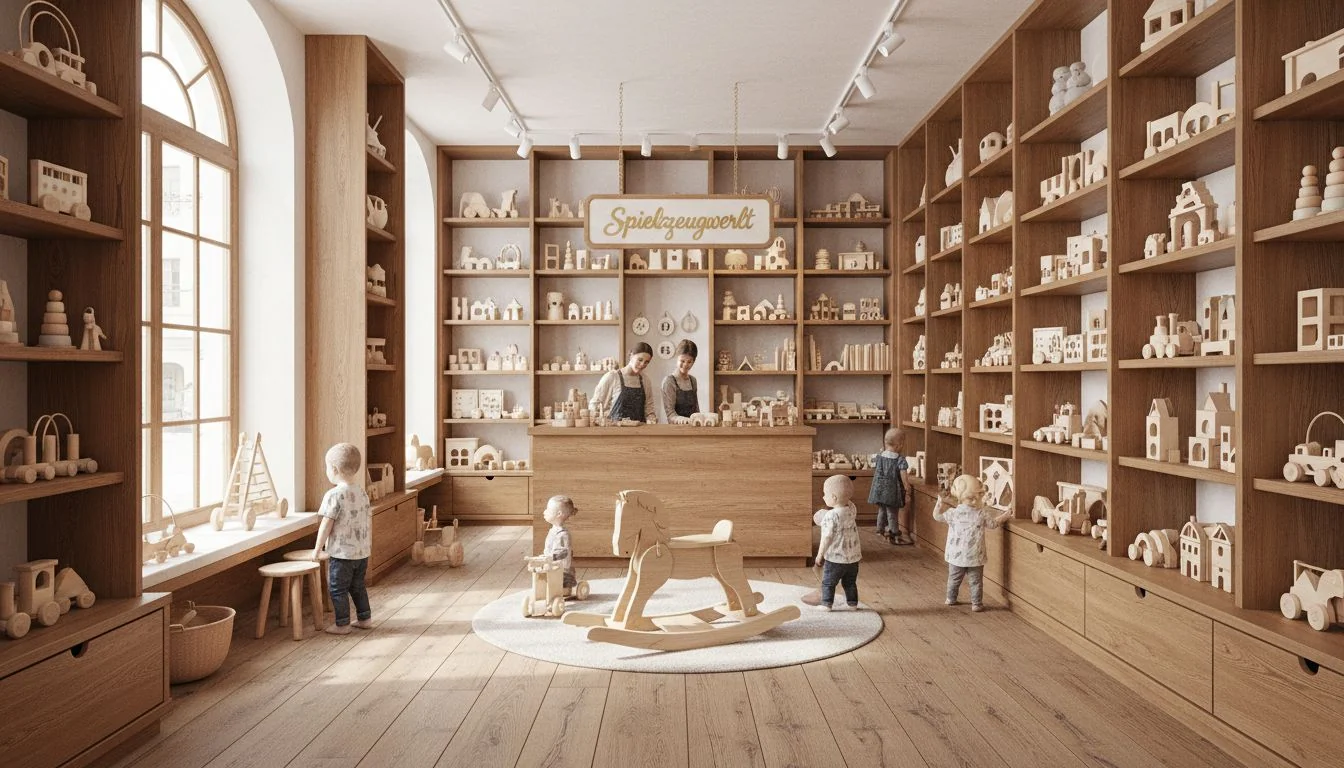
Lokacin da kuke shiga babban kantin sayar da kayan wasan yara a Jamus ko Faransa, kuna fuskantar mataki na ƙarshe na tafiya mai tsayi da rikitarwa. Ga mai zanen samfur kamar ku, Jacky, ainihin aikin yana faruwa ne tun kafin abin wasan yara ya kai ga wannan shiryayye. Shagon shine ƙarshen gaba, amma ƙarshen baya shine game da masana'antu da dabaru.
Boutique vs. The Mass-Market Brand
You will find two main types of players. First, the small, local artisan making truly handmade toys. Their business is small-scale and their costs are high. Second, you have the major brands. These companies operate on a completely different level. Their storefronts and online shops present a story of European design and quality, but their success is built on a global production system. They must meet strict European safety standards, like EN 71, no matter where the factory is located. This is a non-negotiable part of the design and manufacturing specification.
Muhimmancin Curation da Labari mai Kyau
The most successful brands are masters of curation. They don't just sell wooden blocks; they sell a philosophy of creative play, sustainability[^3], ko ilimi. An yi wannan labarin alama a Turai. Yana rinjayar ƙira, marufi, da tallace-tallace. Amma don isar da wannan samfurin a farashin da kasuwa za ta karɓa, dole ne su inganta samarwa. Wannan shine wasan wasa da kowane alamar nasara ta warware.
Wurin kantin sayar da kayan wasan yara yana ba da tabbacin yin kayan wasan a cikin ƙasar.Na ƙarya
Wurin kantin sayar da kayayyaki yana nuna kasuwar da ake so, ba asalin masana'anta ba. Samfuran samfuran duniya suna da shaguna a duk duniya amma suna daidaita samarwa a wani wuri.
Matsayin amincin kayan wasan yara na Turai EN 71 wajibi ne don siyar da kayan wasan yara a cikin EU, ba tare da la'akari da inda aka kera su ba.Na gaskiya
Wannan wata bukata ce ta doka. Duk wani abin wasa da aka shigo da shi cikin EU dole ne a gwada shi kuma a ba shi bodar don ya dace da ka'idodin EN 71, tabbatar da lafiyar yara.
Wadanne Shahararrun Sana'o'i ne suka mamaye Kasuwar Kayan Wasa ta Itace ta Turai?
Kun san sunayen, amma ba ku san labarun kasuwanci a bayan su ba. Ba tare da sanin tsarin aikin su ba, kuna rasa mahimman darussa a cikin sikelin layin samfur. Bari mu kalli wasu shahararrun samfuran kuma mu gano dabarun masana'anta waɗanda suka sanya su sunayen gida.
Alamun kamar Sake[^ 4], Brio, da HABA ƙattai ne a cikin kasuwar kayan wasan katako na Turai. Duk da yake suna da tushe mai ƙarfi na Turai da ƙungiyoyin ƙira, nasarar da suke samu na haɓaka samarwa galibi ta dogara ne akan manyan masana'antun masana'antu, da farko suna cikin China.

These brands are excellent case studies in global manufacturing. They prove that you can maintain a strong European brand identity while leveraging the power of international production. I've worked with clients who wanted to emulate this success, and the first step is always to understand how the leaders do it. Their "brand" is about design, iko mai inganci[^5], and marketing, which happens in Europe. The physical "making" is a different story.
Nazarin Harka: Hape's Global-Local Model
Hape is a perfect example. It was founded in Germany in 1986. Many people assume its toys are made there. However, Hape’s founder recognized the potential of global manufacturing early on. Today, Hape owns and operates a massive, state-of-the-art factory in Ningbo, China. They control the entire process, from raw materials to final product, ensuring high quality while managing costs. Their design and brand management remain deeply rooted in Germany.
Nazarin Harka: Brio da HABA
Brio[^ 6], sanannen alamar Sweden wanda aka kafa a cikin 1884, ya shahara da jiragen ƙasa na katako. Shekaru da yawa, samarwa ya kasance a Sweden. Yayin da kamfanin ya girma kuma kasuwa ta zama mai gasa, ya canza yawancin masana'antar itace da robobi zuwa kasar Sin. Har ila yau ana sarrafa ƙira, ƙirƙira, da tsauraran ƙa'idodi daga Sweden. HABA, wata alamar ƙaunatacciyar Jamusanci, kuma tana amfani da haɗe-haɗe na samar da Jamusanci a cikin gida don wasu abubuwa da amintattun abokan hulɗa na ketare don wasu don biyan bukatun duniya.
| Alamar | Ƙasar Asalin | Wurin Kera Farko | Dabarun Mabuɗin |
|---|---|---|---|
| Sake | Jamus | China (Masana'anta) | Cikakken sarrafa sarkar samar da kayayyaki, ƙirar Jamus. |
| Brio | Sweden | China (An fitar da shi) | Yaren mutanen Sweden zane da kula da inganci, samar da duniya. |
| DOGO[^7] | Jamus | Jamus & Asiya (Gauraye) | "An yi a Jamus" for some lines, global partners for others. |
Hape toys are exclusively manufactured in Germany.Na ƙarya
Hape is a German-founded and managed brand, but its primary manufacturing facility is a large, company-owned factory in Ningbo, China.
Hape, a German-founded brand, owns and operates one of the world's largest wooden toy factories, located in Ningbo, China.Na gaskiya
This vertical integration allows Hape to maintain strict control over quality and production processes while benefiting from China's manufacturing ecosystem.
Ta Yaya A Haƙiƙan Waɗannan Alamomin Suke Gudun Kasuwancin Su?
You see the final product, but the process of design, manufacturing, and logistics is a black box. This knowledge gap makes it hard to apply their strategies to your own projects. Their business model is a masterclass in separating design from production, a strategy I've helped many clients implement.
These brands operate a split model. Design, marketing, and strategy are based in Europe to maintain brand identity. However, high-volume manufacturing is outsourced to or owned in countries with lower production costs, like China, under strict quality control.

I call this the "brains and hands" approach. The "brains" of the operation—the creative design, the brand strategy, the marketing—stay in the home country. The "hands"—the large-scale, labor-intensive manufacturing—are located where it is most efficient. For a product designer, your work must be perfectly translatable to a manufacturing partner thousands of miles away. Clear specifications are everything.
Samfurin Nauyin Rarraba
Here is how it typically works:
- Design & Prototyping (Europe): The product's soul is created here.
- Manufacturer Sourcing (Global): The brand finds a factory that can meet its quality, cost, and volume needs. This is a critical step.
- Tooling & Mass Production (China): This is where the magic of scale happens. For wooden toys, this involves precise CNC cutting, sanding, and painting lines. If there are plastic parts, this involves creating injection molds.
- Quality Control (On-site): The brand has its own team or a third party at the factory to inspect everything.
- Logistics & Distribution (Global): Products are shipped to warehouses in Europe for distribution to stores.
Binciken Amfanin Kuɗi
Let's look at a simple example. The cost difference is staggering.
| Cost Component | Manufacture in Europe | Manufacture in China |
|---|---|---|
| Labor (per unit) | €10 | €2 |
| Materials (per unit) | €5 | €4 |
| Factory Overhead | High | Low |
| Total Unit Cost | ~€20+ | ~€7 |
These are simplified estimates, but they illustrate the core economic reason for this model.
Outsourcing manufacturing means a complete loss of control over quality.Na ƙarya
Successful brands prevent this by implementing rigorous quality control systems, including on-site inspectors, third-party audits, and extremely detailed product specifications.
Successful brands maintain quality control in outsourced factories through dedicated on-site teams, regular audits, and strict adherence to design specifications.Na gaskiya
This is a fundamental part of the business model. Brands invest heavily in quality assurance to protect their reputation and ensure product safety.
You know the big players, but market share[^8] might seem like a metric for CEOs, not designers. But without this context, you're designing in a vacuum, unaware of the scale required to succeed. Market share reveals the dominance of this global production model.
The European wooden toy market is valued at several billion euros. Major brands using global manufacturing hold a significant share. This shows that the best path to capturing a large market involves leveraging cost-effective, high-volume production, typically outside of Europe.

Market share is not just a number; it is proof of a successful business model. The brands with the biggest share are the ones who have perfected the design-in-Europe, manufacture-in-Asia strategy. For a designer like you, Jacky, this is a critical insight. If you design a new toy, the business plan will almost certainly involve overseas manufacturing to be competitive. Your designs must be optimized for that reality from day one.
Understanding the Numbers
The global toy market is worth over $100 billion, and Europe is a huge piece of that pie. Within this market, wooden toys are a growing niche, valued for their perceived sustainability and quality. However, the brands that dominate this niche are not small local artisans. They are large corporations with massive production capabilities. Their market share proves that consumers value the combination of European design and accessible pricing that this model provides.
I've seen clients with brilliant designs fail because they couldn't get the manufacturing cost right. They tried to produce locally at a small scale and were priced out of the market. I've also seen clients with a solid, but not revolutionary, design succeed because they embraced the global model from the start. They understood that to compete with Hape or Brio, they had to play the same game. Their market share grew because their products were well-designed, safe, and affordable—a trio made possible only by smart, global manufacturing.
The European toy market is one of the largest in the world, with Germany, the UK, and France being the top three markets.Na gaskiya
These three countries consistently represent the largest share of toy sales in Europe, making them key targets for any major toy brand.
Niche, locally-made wooden toy brands hold the largest share of the European market.Na ƙarya
While locally-made brands are valued, their production capacity and price points are not competitive for the mass market. Large, globally-produced brands hold the dominant market share.
Ƙarshe
The success of European wooden toy brands is not just about charming design. It's about smart, global manufacturing. For designers, understanding this production reality is crucial for creating viable, successful products.
Magana
[^1]: Explore how a global supply chain impacts the pricing and availability of wooden toys.
[^2]: Explore the significance of design philosophy in shaping successful toy brands.
[^3]: Discover how sustainability is integrated into the production of wooden toys.
[^4]: Discover how Hape balances design and production to maintain quality and affordability.
[^5]: Learn about the best practices for maintaining quality in outsourced manufacturing.
[^6]: Understand Brio's approach to manufacturing and how it affects their product quality.
[^7]: Find out how HABA combines local and global production to meet demand.
[^8]: Investigate the market dynamics and share of wooden toys in the European market.

