

Je bewondert prachtig Europees houten speelgoed, maar snapt niet hoe het voor een redelijke prijs verkocht wordt. Het idee van lokale, handgemaakte productie lijkt onmogelijk voor merken op de massamarkt. Het antwoord ligt in een mondiale productiestrategie die ik uit de eerste hand heb gezien.
Het geheim achter veel bekende Europese houten speelgoedmerken is niet lokaal vakmanschap voor massaproductie. Het is een slimme mondiale toeleveringsketen[^1]. Het merendeel van de bulkproductie, inclusief vormgeving en afwerking, gebeurt in gespecialiseerde fabrieken in China om de kosten te beheersen en effectief te schalen.

Dit zal je misschien verbazen, maar het is een realiteit waarmee ik al jaren in de productiewereld navigeer. Ik heb talloze klanten geholpen hun bedrijf op dit model op te bouwen. Het is een klassiek geval van merkperceptie versus productierealiteit, waarbij de ‘Made In" verhaal is complexer dan een enkel label. Dit begrijpen is essentieel voor elke ontwerper die een product wil creëren dat niet alleen mooi is, maar ook commercieel levensvatbaar. Laten we eens kijken hoe dit allemaal werkt, te beginnen met de merken en winkels zelf.
Al het houten speelgoed dat in Europese winkels wordt verkocht, is handgemaakt in Europa.Vals
Hoewel sommige niche- en boetiekspeelgoed handgemaakt zijn in Europa, besteedt de overgrote meerderheid van de merken op de massamarkt de productie uit aan landen als China om kostenconcurrerend te blijven.
Veel grote Europese speelgoedmerken besteden hun massaproductie uit naar landen als China.WAAR
Merken als Hape, Brio en anderen maken gebruik van de productie in China vanwege de schaal, efficiëntie en kostenvoordelen, terwijl ze het ontwerp en de marketing in Europa behouden.
Wat definieert een beste houten speelgoedwinkel in Europa?
You see countless toy stores, but it's hard to tell which ones are just retailers. You want to understand the business model behind the brand. This makes it difficult to analyze their production strategy. The best ones curate a specific identity, which dictates their entire manufacturing approach.
A top European wooden toy store is the face of a brand, not just a shop. It is defined by a strong design philosophy[^2], high safety standards like EN 71, and a curated collection that tells a story, even if the products are made globally.
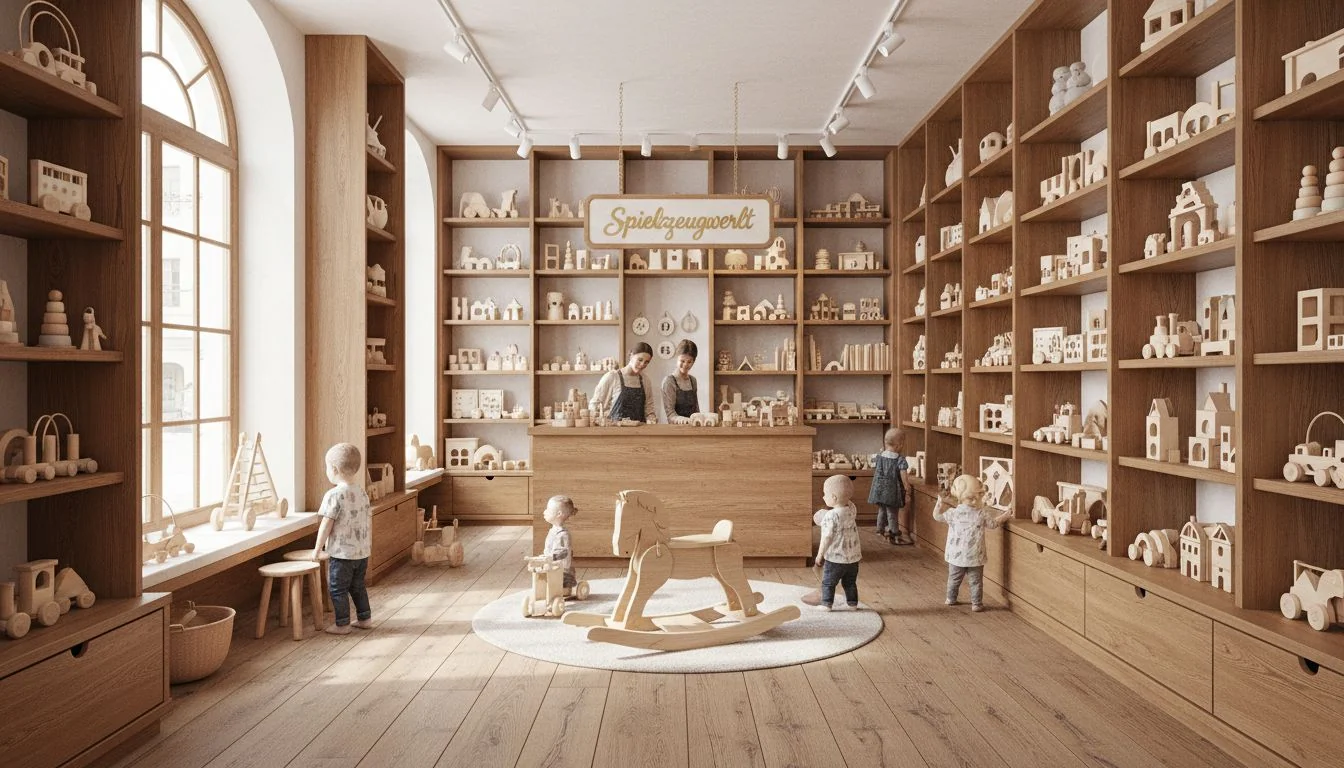
Wanneer je in Duitsland of Frankrijk een luxe speelgoedwinkel binnenloopt, beleef je de laatste stap van een zeer lange en complexe reis. Voor een productontwerper als jij, Jacky, gebeurt het echte werk lang voordat speelgoed ooit op de plank komt. De winkel is de voorkant, maar de achterkant draait helemaal om productie en logistiek.
De boetiek versus het massamarktmerk
Er zijn twee hoofdtypen spelers. Ten eerste de kleine, lokale ambachtsman die echt handgemaakt speelgoed maakt. Hun bedrijf is kleinschalig en de kosten zijn hoog. Ten tweede heb je de grote merken. Deze bedrijven opereren op een heel ander niveau. Hun winkelpuien en online winkels presenteren een verhaal van Europees design en kwaliteit, maar hun succes is gebaseerd op een mondiaal productiesysteem. Ze moeten voldoen aan strenge Europese veiligheidsnormen, zoals EN 71, waar de fabriek zich ook bevindt. Dit is een niet-onderhandelbaar onderdeel van de ontwerp- en productiespecificatie.
Het belang van curatie en merkverhaal
De meest succesvolle merken zijn meesters in curatie. Ze verkopen niet alleen houten blokken; ze verkopen een filosofie van creatief spel, duurzaamheid[^3], of onderwijs. Dit merkverhaal is gemaakt in Europa. Het beïnvloedt het ontwerp, de verpakking en de marketing. Maar om dat product te leveren tegen een prijs die de markt accepteert, moeten ze de productie optimaliseren. Dit is de puzzel die elk succesvol merk heeft opgelost.
De locatie van een speelgoedwinkel garandeert dat het speelgoed in dat land wordt gemaakt.Vals
De locatie van een winkel weerspiegelt de doelgroep, niet de oorsprong van de productie. Mondiale merken hebben winkels over de hele wereld, maar centraliseren de productie elders.
De Europese speelgoedveiligheidsnorm EN 71 is een verplichte vereiste voor speelgoed dat in de EU wordt verkocht, ongeacht waar het wordt vervaardigd.WAAR
This is a legal requirement. Any toy imported into the EU must be tested and certified to meet EN 71 standards, ensuring it is safe for children.
Welke bekende merken domineren de Europese markt voor houten speelgoed?
You know the names, but you don't know the business stories behind them. Without knowing their operational models, you're missing key lessons in scaling a product line. Let's look at some famous brands and uncover the manufacturing strategies that made them household names.
Brands like Opnieuw[^4], Brio, and HABA are giants in the European wooden toy market. While they have strong European roots and design teams, their success in scaling production often relies on large-scale manufacturing facilities, primarily located in China.

These brands are excellent case studies in global manufacturing. They prove that you can maintain a strong European brand identity while leveraging the power of international production. I've worked with clients who wanted to emulate this success, and the first step is always to understand how the leaders do it. Their "brand" is about design, kwaliteitscontrole[^5], and marketing, which happens in Europe. The physical "making" is a different story.
Casestudy: het mondiaal-lokale model van Hape
Hape is a perfect example. It was founded in Germany in 1986. Many people assume its toys are made there. However, Hape’s founder recognized the potential of global manufacturing early on. Today, Hape owns and operates a massive, state-of-the-art factory in Ningbo, China. They control the entire process, from raw materials to final product, ensuring high quality while managing costs. Their design and brand management remain deeply rooted in Germany.
Casestudy: Brio en HABA
Brio[^6], a classic Swedish brand founded in 1884, is famous for its wooden trains. For decades, production was in Sweden. As the company grew and the market became more competitive, it shifted most of its wood and plastic manufacturing to China. The design, innovation, and strict quality standards are still managed from Sweden. HABA, another beloved German brand, also uses a mix of in-house German production for certain items and trusted overseas partners for others to meet global demand.
| Brand | Country of Origin | Primary Manufacturing Location | Key Strategy |
|---|---|---|---|
| Opnieuw | Germany | China (Owns factory) | Full control of the supply chain, German design. |
| Brio | Sweden | China (Outsourced) | Swedish design and quality control, global production. |
| LANG[^7] | Germany | Germany & Asia (Mixed) | "Made in Germany" for some lines, global partners for others. |
Hape toys are exclusively manufactured in Germany.Vals
Hape is a German-founded and managed brand, but its primary manufacturing facility is a large, company-owned factory in Ningbo, China.
Hape, a German-founded brand, owns and operates one of the world's largest wooden toy factories, located in Ningbo, China.WAAR
This vertical integration allows Hape to maintain strict control over quality and production processes while benefiting from China's manufacturing ecosystem.
Hoe runnen deze merken hun bedrijf eigenlijk?
You see the final product, but the process of design, manufacturing, and logistics is a black box. This knowledge gap makes it hard to apply their strategies to your own projects. Their business model is a masterclass in separating design from production, a strategy I've helped many clients implement.
These brands operate a split model. Design, marketing, and strategy are based in Europe to maintain brand identity. However, high-volume manufacturing is outsourced to or owned in countries with lower production costs, like China, under strict quality control.

I call this the "brains and hands" approach. The "brains" of the operation—the creative design, the brand strategy, the marketing—stay in the home country. The "hands"—the large-scale, labor-intensive manufacturing—are located where it is most efficient. For a product designer, your work must be perfectly translatable to a manufacturing partner thousands of miles away. Clear specifications are everything.
Het gedeelde verantwoordelijkheidsmodel
Here is how it typically works:
- Ontwerp & Prototyping (Europe): The product's soul is created here.
- Manufacturer Sourcing (Global): The brand finds a factory that can meet its quality, cost, and volume needs. This is a critical step.
- Gereedschap & Mass Production (China): This is where the magic of scale happens. For wooden toys, this involves precise CNC cutting, sanding, and painting lines. If there are plastic parts, this involves creating injection molds.
- Quality Control (On-site): The brand has its own team or a third party at the factory to inspect everything.
- Logistiek & Distribution (Global): Products are shipped to warehouses in Europe for distribution to stores.
De kosten-batenanalyse
Let's look at a simple example. The cost difference is staggering.
| Kostencomponent | Manufacture in Europe | Manufacture in China |
|---|---|---|
| Labor (per unit) | €10 | €2 |
| Materials (per unit) | €5 | €4 |
| Factory Overhead | Hoog | Laag |
| Total Unit Cost | ~€20+ | ~€7 |
These are simplified estimates, but they illustrate the core economic reason for this model.
Outsourcing manufacturing means a complete loss of control over quality.Vals
Successful brands prevent this by implementing rigorous quality control systems, including on-site inspectors, third-party audits, and extremely detailed product specifications.
Successful brands maintain quality control in outsourced factories through dedicated on-site teams, regular audits, and strict adherence to design specifications.WAAR
This is a fundamental part of the business model. Brands invest heavily in quality assurance to protect their reputation and ensure product safety.
You know the big players, but market share[^8] might seem like a metric for CEOs, not designers. But without this context, you're designing in a vacuum, unaware of the scale required to succeed. Market share reveals the dominance of this global production model.
The European wooden toy market is valued at several billion euros. Major brands using global manufacturing hold a significant share. This shows that the best path to capturing a large market involves leveraging cost-effective, high-volume production, typically outside of Europe.

Marktaandeel is niet slechts een getal; het is het bewijs van een succesvol bedrijfsmodel. De merken met het grootste aandeel zijn degenen die de strategie van design in Europa en productie in Azië hebben geperfectioneerd. Voor een ontwerper als jij, Jacky, is dit een cruciaal inzicht. Als je nieuw speelgoed ontwerpt, zal het businessplan vrijwel zeker betrekking hebben op productie in het buitenland om concurrerend te kunnen zijn. Jouw ontwerpen moeten vanaf dag één geoptimaliseerd zijn voor die realiteit.
De cijfers begrijpen
The global toy market is worth over $100 billion, and Europe is a huge piece of that pie. Within this market, wooden toys are a growing niche, valued for their perceived sustainability and quality. However, the brands that dominate this niche are not small local artisans. They are large corporations with massive production capabilities. Their market share proves that consumers value the combination of European design and accessible pricing that this model provides.
I've seen clients with brilliant designs fail because they couldn't get the manufacturing cost right. They tried to produce locally at a small scale and were priced out of the market. I've also seen clients with a solid, but not revolutionary, design succeed because they embraced the global model from the start. They understood that to compete with Hape or Brio, they had to play the same game. Their market share grew because their products were well-designed, safe, and affordable—a trio made possible only by smart, global manufacturing.
The European toy market is one of the largest in the world, with Germany, the UK, and France being the top three markets.WAAR
These three countries consistently represent the largest share of toy sales in Europe, making them key targets for any major toy brand.
Niche, locally-made wooden toy brands hold the largest share of the European market.Vals
While locally-made brands are valued, their production capacity and price points are not competitive for the mass market. Large, globally-produced brands hold the dominant market share.
Conclusie
The success of European wooden toy brands is not just about charming design. It's about smart, global manufacturing. For designers, understanding this production reality is crucial for creating viable, successful products.
Referenties
[^1]: Explore how a global supply chain impacts the pricing and availability of wooden toys.
[^2]: Explore the significance of design philosophy in shaping successful toy brands.
[^3]: Discover how sustainability is integrated into the production of wooden toys.
[^4]: Discover how Hape balances design and production to maintain quality and affordability.
[^5]: Learn about the best practices for maintaining quality in outsourced manufacturing.
[^6]: Understand Brio's approach to manufacturing and how it affects their product quality.
[^7]: Find out how HABA combines local and global production to meet demand.
[^8]: Investigate the market dynamics and share of wooden toys in the European market.
